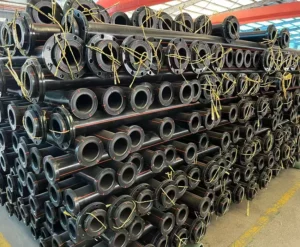
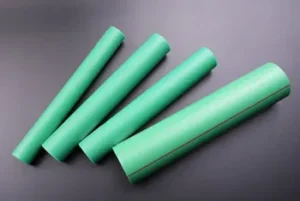
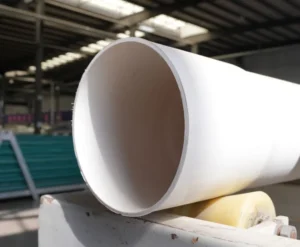
PE siphon pipes are high-density polyethylene (HDPE) pipes engineered specifically for siphon drainage systems—the high-efficiency rainwater removal systems used in large buildings, stadiums, airports, and industrial facilities. Unlike standard gravity drainage, siphon systems operate under negative pressure, requiring pipes with exceptional dimensional stability, smooth interior surfaces, and minimal shrinkage to maintain watertight joints and hydraulic performance over decades of service.
The production of PE siphon pipes follows a precision-controlled extrusion process that differs from standard PE pipe manufacturing in one critical respect: the use of tempered cooling to achieve a shrinkage rate of just 0.6–0.8%, compared to approximately 3% for pipes cooled with ambient-temperature water. This article provides a systematic overview of the PE siphon pipe production process, covering each stage from raw material preparation to finished product testing.
1. Raw Material Preparation
1.1 HDPE Compound Selection
PE siphon pipes are manufactured from high-density polyethylene (HDPE) compounds—typically PE80 or PE100 grades—selected for their high melt viscosity, excellent stress crack resistance, and long-term hydrostatic strength. The compound is supplied as natural-colored pellets, with carbon black or color pigments added for UV protection and identification.
1.2 Additive Formulation
The additive package for siphon pipe compounds typically includes:
- Carbon black (2–2.5%) for UV stabilization
- Antioxidants to prevent thermal degradation during extrusion
- Processing stabilizers to improve melt flow
- Color masterbatch for identification (often green, gray, or black)
For specialized applications, such as antistatic siphon drainage pipes, additional components such as nano-zinc oxide coatings and antistatic agents may be incorporated.
1.3 Drying
Polyethylene itself is hydrophobic, but compounds containing carbon black and color pigments can be hygroscopic in nature. If moisture content exceeds 0.03 w/w%, problems can arise during extrusion, including void formation in the pipe wall and rough pipe surfaces. The compound is therefore dried in a hopper dryer at 70–90°C for 1.5–2 hours before extrusion.
2. Extrusion: Core Pipe Formation
2.1 Feeding and Melt Conveying
Dried pellets are conveyed through a vacuum feeding system to the extruder hopper. For PE siphon pipe production, a single-screw extruder is typically used, with screw diameters ranging from 0.5 to 3.5 inches for small tubing up to much larger diameters for building drainage pipes.
The essential steps are to heat, melt, mix, and convey the raw material into the desired annular shape and hold that shape during cooling.
2.2 Temperature Profile
The extrusion temperature profile for HDPE siphon pipes is carefully controlled to ensure complete plasticization without thermal degradation. A typical profile is:
| Zone | Temperature Range |
|---|---|
| Feed zone | 180–200°C |
| Compression zone | 190–210°C |
| Metering zone | 200–220°C |
| Die head | 200–220°C |
At the die exit, the molten polyethylene temperature is typically around 210°C.
2.3 Die Head and Annular Formation
The molten polymer is forced through an annular die, which distributes the homogeneous polyethylene melt around a solid mandrel to form a tubular shape. For siphon pipes requiring color identification stripes, a co-extruder may be used to apply color strips during extrusion.
For reinforced siphon tubes—used in demanding applications—metal wire reinforcing agents can be placed at 90° intervals around the circumference of the tube wall during extrusion.
3. Tempering Cooling: The Critical Differentiator
3.1 The Problem with Conventional Cooling
Standard PE pipe production cools the extruded pipe immediately with ambient-temperature water. However, polyethylene is a highly crystalline polymer. When quenched rapidly, the polymer chains do not have time to arrange themselves in an orderly fashion, resulting in a loosely packed, disordered structure. This uneven crystallization generates internal stress, leading to a shrinkage rate of approximately 3% during service—unacceptable for siphon drainage systems where dimensional stability is critical.
3.2 The Tempering Solution
PE siphon pipe production employs a patented tempering cooling process using a specially designed annular vacuum tempering tank. The process works as follows:
- Pre-heating: Water in the tempering tank is pre-heated to 58–62°C (typically 60°C).
- Spray tempering: The high-temperature molten pipe (at approximately 210°C) passes through the annular vacuum tempering tank, where pre-heated water is sprayed uniformly around the pipe circumference through distributed nozzles.
- Gradual crystallization: The molten polyethylene forms a thin shell on the outer wall, which begins to crystallize first. This cooled shell acts as an insulating layer, allowing the inner molten material to crystallize slowly over a longer period, promoting crystal nucleation and growth.
- Double pass: In one documented embodiment, the pipe passes through the tempering tank twice to ensure thorough, gradual cooling.
3.3 Results: Dramatic Shrinkage Reduction
The tempering process transforms the crystallization behavior of the polyethylene, producing a stable, orderly crystalline structure. The result is a shrinkage rate of just 0.6–0.8%—a 75% reduction compared to conventionally cooled pipes. This ensures that the pipe maintains its dimensions and shape throughout its service life, preventing joint failures and maintaining the precise tolerances required for siphon drainage system performance.
4. Sizing and Further Cooling
4.1 Vacuum Sizing
After tempering, the pipe passes through a sizing sleeve (also called a calibration sleeve) where vacuum is applied to set the final outer diameter. The sizing device fixes the pipe’s dimensions while the material is still in a semi-molten state.
4.2 Ambient Cooling Tank
Following sizing, the pipe enters a conventional ambient-temperature cooling tank for final cooling and solidification. Water is sprayed on the pipe exterior to bring it to room temperature. The combination of tempering followed by ambient cooling ensures both dimensional accuracy and minimal internal stress.
4.3 Multi-Stage Cooling for Stress Relief
Advanced production lines may employ multi-stage cooling to further reduce residual stress. One patent describes a process where the pipe exiting the cooling tank is reheated for annealing to eliminate residual stress caused by cooling.
5. Haul-Off, Marking, and Cutting
5.1 Haul-Off
The cooled and solidified pipe is pulled forward by a caterpillar or belt-type haul-off unit. The haul-off speed must precisely match the extrusion rate to maintain consistent wall thickness and dimensional accuracy.
5.2 Printing
A printing device is inserted into the production line to mark the extruded pipe with essential identification information, including:
- Production month and year
- Pipe size and pressure rating
- Standard reference
- Manufacturer identification
5.3 Cutting
The pipe is cut to specified lengths using a planetary cutter or flying saw synchronized with the haul-off speed. Finished pipes are then either coiled for smaller diameters or cut to length for larger diameters.
6. Quality Control
Quality control for PE siphon pipes encompasses raw material inspection, in-process monitoring, and finished product testing.
6.1 Raw Material Testing
Incoming polyethylene materials are inspected for:
- Density (per ASTM D1505)
- Melt flow rate (per ASTM D1238)
- Contamination and carbon black dispersion
6.2 In-Process Monitoring
- Melt temperature and pressure: Continuous monitoring
- Wall thickness: Online ultrasonic measurement
- Tempering tank temperature: Maintained at 58–62°C
- Surface quality: Visual inspection for bubbles, scratches, and discoloration
6.3 Finished Product Testing
PE siphon pipes must comply with standards including AWWA C906 and relevant ISO standards. Key tests include:
| Test Item | Test Method | Purpose |
|---|---|---|
| Longitudinal reversion | Heating at 110°C for 1 hour | Verify shrinkage rate (target: ≤0.8%) |
| Hydrostatic strength | 80°C, 165 hours | Verify long-term pressure resistance |
| Melt flow rate | 190°C, 5 kg load | Verify material consistency |
| Oxidation induction time | 210°C | Verify thermal stability |
| Carbon black content | TGA or muffle furnace | Verify UV protection |
| Dimensional inspection | Diameter, wall thickness, length | Verify dimensional accuracy |
| Air tightness test | Negative pressure test | Verify system integrity |
7. Key Process Parameters Summary
| Stage | Parameter | Typical Value |
|---|---|---|
| Drying | Temperature / Time | 70–90°C / 1.5–2 hours |
| Extrusion | Melt temperature | 200–220°C |
| Tempering | Water temperature | 58–62°C |
| Tempering | Passes through tank | 1–2 passes |
| Sizing | Vacuum pressure | –0.02 to –0.06 MPa |
| Ambient cooling | Water temperature | 15–20°C |
| Haul-off | Line speed | Matched to extrusion rate |
| Shrinkage rate | Final product | 0.6–0.8% |
Frequently Asked Questions
Q1: What makes PE siphon pipe production different from standard PE pipe production?
The key difference is the tempering cooling process. Standard PE pipes are cooled immediately with ambient-temperature water, resulting in a shrinkage rate of approximately 3%. PE siphon pipes use a pre-heated tempering tank at 58–62°C that allows gradual crystallization, reducing shrinkage to just 0.6–0.8%.
Q2: Why is low shrinkage so important for siphon drainage systems?
Siphon drainage systems operate under negative pressure and rely on precisely fitted joints. High shrinkage would cause pipes to contract over time, leading to joint separation, leaks, and loss of system performance. Low shrinkage ensures dimensional stability throughout the pipe’s 50-year service life.
Q3: What resin grades are used for PE siphon pipes?
PE80 and PE100 grades are commonly used, selected for their high melt viscosity, stress crack resistance, and long-term hydrostatic strength.
Q4: How does the tempering process work at the molecular level?
Tempering allows the polyethylene to crystallize gradually. A thin crystalline shell forms on the outer wall first, acting as insulation that slows cooling of the inner material. This promotes orderly crystal nucleation and growth, resulting in a stable, densely packed crystalline structure with minimal internal stress.
Q5: What standards apply to PE siphon pipe quality control?
Key standards include AWWA C906 (Polyethylene Pressure Pipe and Fittings) and relevant ISO standards. Finished products are tested for longitudinal reversion, hydrostatic strength, melt flow rate, and carbon black content.
Conclusion
PE siphon pipe production is a precision-engineered extrusion process that differs from standard PE pipe manufacturing in its critical use of tempered cooling. By pre-heating cooling water to 58–62°C and allowing gradual crystallization, manufacturers achieve a shrinkage rate of just 0.6–0.8%—a dramatic improvement over the approximately 3% shrinkage of conventionally cooled pipes.