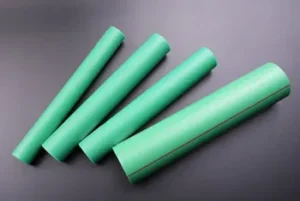
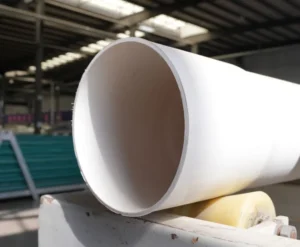
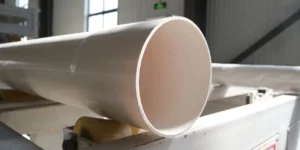
PPR (Polypropylene Random Copolymer) pipe manufacturing is a continuous extrusion process that transforms polypropylene random copolymer pellets into finished pipes for hot and cold water supply, heating systems, and industrial fluid transport. Unlike PVC pipe production, which typically uses twin-screw extruders, PPR pipe production typically employs single-screw extrusion with vacuum sizing and multi-stage cooling to achieve the precise dimensional accuracy and material properties required for pressure-rated piping.
This article provides a systematic overview of the PPR pipe production process, covering each stage from raw material preparation to finished product testing.
1. Raw Material Preparation
1.1 PPR Compound
A PPR pipe factory does not compound its own plastic. It purchases a finished compound—polypropylene random copolymer, already stabilized and carrying its additive package, delivered as natural-colored pellets in 25 kg bags or bulk sacks. Resin typically accounts for 70–85% of the cost of making PPR pipe.
Leading resin grades (such as Borealis RA130E) run a melt flow rate of 0.25 g/10 min at 230°C/2.16 kg, well below the ISO 15874-2 ceiling of 0.5 g/10 min. The resin producer specifies the extrusion window: Borealis specifies a melt temperature of 220°C, while Hyosung specifies 200–220°C.
1.2 Masterbatch and Additives
Color masterbatch is added at the feeding stage to produce the characteristic green, white, or gray appearance of PPR pipes. Additional additives may include antioxidants and UV stabilizers, depending on the intended application. The masterbatch is mixed with the PPR compound at a controlled ratio, typically 1–3 wt%.
1.3 Drying
PPR pellets can absorb moisture during storage and transport. If moisture is not removed, it can cause surface bubbles and defects during extrusion. The compound is dried in a hot-air circulating oven at 60–100°C for 2–4 hours to reduce moisture content to below 0.1%.
2. Feeding and Extrusion
2.1 Vacuum Feeding
Dried pellets and masterbatch are conveyed through a vacuum feeding system to the extruder hopper. This automated system eliminates manual handling and ensures consistent material supply.
2.2 Single-Screw Extrusion
PPR pipe production uses a single-screw extruder as the primary plasticizing and conveying unit. The screw, barrel, gearbox, motor drive, and heater zones are matched to PPR processing requirements for stable plasticizing and melt delivery.
The typical extrusion temperature profile is:
| Zone | Temperature Range |
|---|---|
| Feed zone | 180–200°C |
| Compression zone | 190–210°C |
| Metering zone | 200–220°C |
| Die head | 195–210°C |
The melt temperature is typically maintained at 200–220°C depending on the specific resin grade and pipe dimensions. During extrusion, the screw rotates at 60–90 r/min, plasticizing the material over 6–10 minutes before it reaches the die.
2.3 Die Head and Pipe Formation
The molten polymer is forced through a spiral mandrel die head, which distributes the melt evenly around the pipe circumference. For multi-layer PPR pipes (such as glass fiber reinforced or aluminum foil barrier pipes), a co-extrusion die head distributes each material layer uniformly, ensuring consistent layer structure and wall thickness.
The die head temperature is typically controlled at 195–210°C. The annular gap between the mandrel and the die determines the initial wall thickness of the pipe before sizing.
3. Vacuum Sizing and Cooling
3.1 Vacuum Sizing
Immediately after exiting the die, the hot tubular parison enters the vacuum calibration tank. This is where the pipe’s diameter and roundness are set—not by the die, but by the sizing sleeve. Under a vacuum negative pressure of –0.02 to –0.06 MPa, the pipe is pressed against the inner wall of the sizing sleeve, achieving precise outer diameter dimensions.
Cooling water at 15–20°C circulates through the sizing tank, rapidly cooling the pipe surface and freezing the shape.
3.2 Multi-Stage Cooling
After vacuum sizing, the pipe enters a series of spray cooling tanks for progressive cooling. Modern production lines use closed-loop cooling systems with filtration, water level control, and flow monitoring to reduce warping and stabilize final dimensions.
Advanced equipment employs a three-stage cooling mode: rapid cooling for initial shape setting, constant-temperature slow release for stress relaxation, and low-temperature shaping for dimensional stability. This differentiated cooling approach minimizes internal stress and improves pipe toughness.
4. Haul-Off, Marking, and Cutting
4.1 Haul-Off
The cooled and sized pipe is pulled forward by a caterpillar or belt-type haul-off unit. The haul-off speed must precisely match the extrusion speed to maintain consistent wall thickness. Typical production speeds range from 5–20 m/min depending on pipe diameter.
4.2 Online Melt Monitoring
Modern PPR pipe production lines are equipped with online melt monitoring devices that detect melt temperature, pressure, and dispersion in real time. Temperature sensors, pressure sensors, and optical scattering probes continuously monitor melt quality, allowing operators to detect and correct process deviations before they affect pipe quality.
4.3 Marking
The pipe passes through an inkjet or laser marking system that prints essential identification information at least once per meter. Per ISO 15874 requirements, the marking must carry eight specified items, including the production month and year, pipe size, pressure rating, standard reference, and manufacturer identification.
4.4 Cutting
A flying saw or planetary cutter cuts the pipe to the required length without interrupting production. The cutting unit is synchronized with the haul-off speed to ensure clean, accurate cuts. After cutting, pipes are stacked or coiled depending on diameter.
5. Quality Control
PPR pipe quality control encompasses raw material inspection, in-process monitoring, and finished product testing.
5.1 Raw Material Testing
- Melt Flow Rate (MFR): Measured at 230°C/2.16 kg to verify resin consistency
- Oxidation Induction Time (OIT): Evaluates thermal stability of the compound
- Moisture content: Must be below 0.1% before extrusion
5.2 In-Process Monitoring
- Melt temperature and pressure: Continuous monitoring via online sensors
- Wall thickness: Online ultrasonic or laser measurement
- Surface quality: Visual inspection for bubbles, scratches, and discoloration
5.3 Finished Product Testing
PPR pipes must comply with international standards including ISO 15874 (hot and cold water systems), DIN 8077/8078, and ASTM F2389. Key tests include:
| Test Item | Test Method | Purpose |
|---|---|---|
| Hydrostatic test (short-term) | 20°C, 1 hour, pressure applied | Verify immediate pressure resistance |
| Hydrostatic test (long-term) | 95°C, 1,000+ hours | Verify long-term durability |
| Impact test | Charpy or Izod impact | Evaluate low-temperature toughness |
| Longitudinal reversion | Heating at 135°C for 1 hour | Assess internal stress |
| Vicat softening temperature | Thermal deformation test | Verify heat resistance |
| Melt Flow Rate | 230°C/2.16 kg | Verify material consistency |
| Ash content | Combustion and weighing | Verify filler content |
| Optical properties | Color, turbidity, taste, odor | Verify drinking water safety |
The long-term hydrostatic test behind a PPR pipe pressure class runs 8,760 hours at 110°C—a full year of testing that qualified the design.
6. Key Process Parameters Summary
| Stage | Parameter | Typical Value |
|---|---|---|
| Drying | Temperature / Time | 60–100°C / 2–4 hours |
| Extrusion | Melt temperature | 200–220°C |
| Extrusion | Screw speed | 60–90 r/min |
| Sizing | Vacuum pressure | –0.02 to –0.06 MPa |
| Cooling | Water temperature | 15–20°C |
| Haul-off | Line speed | 5–20 m/min |
Frequently Asked Questions
Q1: What is the difference between PPR pipe production and PVC pipe production?
PPR production uses single-screw extrusion with vacuum sizing and multi-stage cooling, while PVC production typically uses twin-screw extrusion. PPR also requires higher melt temperatures (200–220°C) and careful temperature control due to the material’s thermal sensitivity.
Q2: Why is raw material drying necessary for PPR pipe production?
PPR pellets absorb moisture during storage and transport. If moisture is not removed before extrusion, it causes surface bubbles, voids, and reduced mechanical strength in the finished pipe.
Q3: How is the pipe diameter controlled during production?
The diameter is set in the vacuum calibration tank, not by the die. A sizing sleeve inside the vacuum tank holds the pipe against its inner wall under negative pressure while cooling water freezes the shape.
Q4: What standards must PPR pipes comply with?
Key standards include ISO 15874 (hot and cold water systems), DIN 8077/8078 (Germany), ASTM F2389 (USA), and GB/T 18742 (China).
Q5: How long does the hydrostatic pressure test take?
Short-term hydrostatic testing runs at 20°C for 1 hour. Long-term testing runs at 95°C for 1,000 hours or more. The qualifying test for a PPR pipe class runs 8,760 hours at 110°C.
Conclusion
PPR pipe production is a precision-controlled extrusion process that transforms polypropylene random copolymer pellets into high-performance piping for hot and cold water systems. From raw material drying and single-screw extrusion through vacuum sizing, multi-stage cooling, and rigorous quality testing, every stage requires careful attention to temperature, pressure, and material flow.