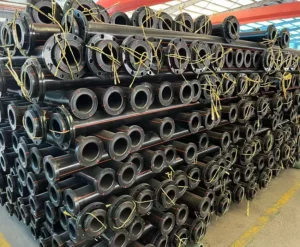
PVC pipe manufacturing is a continuous extrusion process that converts a dry blend of PVC resin and additives into rigid pipe through precisely controlled heating, forming, sizing, and cooling stages. What distinguishes PVC from most other pipe materials is its thermal sensitivity: PVC degrades if overheated, so the entire line—from mixing temperatures to screw speed to cooling length—must be engineered around keeping the material within a narrow processing window.
This guide traces the complete production chain, from dry-blend preparation through extrusion, calibration, cooling, and haul-off, with the key parameters and troubleshooting logic that govern product quality.
1. Why PVC Pipe Production Is Different
PVC pipe production differs from PE pipe extrusion in two fundamental respects. First, PVC dry blend requires high-speed hot mixing and cooling before it can be fed to the extruder, because the additives must be uniformly dispersed and the compound must be thermally stabilized before processing. Second, rigid PVC pipe is almost universally produced on a conical twin-screw extruder, which provides the strong conveying and mixing action needed for PVC dry blend.
The conical twin-screw geometry—screws with diameters that vary along the processing length, typically from 65 mm to 130 mm—creates increasing shear intensity as material progresses toward the die. This design delivers 30–40% higher torque capacity than parallel designs of equivalent motor power, enabling high-fill formulations (up to 85% calcium carbonate loading) while reducing energy consumption by approximately 15–20%.
2. Raw Material Preparation and Compounding
2.1 Formulation
A rigid PVC pipe formulation typically contains PVC resin, calcium carbonate filler, heat stabilizer, lubricant, impact modifier, and colorant. The exact formulation is determined by the extruder’s plasticizing capacity—a single universal recipe is not appropriate across different equipment.
2.2 Dry-Blend Mixing: Hot Mix and Cold Mix
The compounding stage has two distinct thermal steps.
Hot mixing raises the material temperature to approximately 120°C under high-speed blade action. The mechanical friction and convection disperse the additives and begin pre-plasticizing the compound. The temperature must be measured accurately, because excessive heat will degrade the PVC.
Cold mixing then cools the hot blend to approximately 40°C before it is transferred to the extruder hopper. This step serves three purposes: it prevents PVC decomposition from prolonged exposure to elevated temperature, avoids material agglomeration, and stabilizes the feed so that extruder torque fluctuation is minimized. In a documented process, the material is held after cold mixing for at least 12 hours before production to eliminate internal stress.
Practical note: If the dry blend is unstable, the resulting pipe will show surface defects, unstable diameter, poor impact strength, or inconsistent color. A stable mixer is part of the production line, not an optional auxiliary.
3. Extrusion: Plasticizing and Pipe Forming
3.1 Feeding and Plasticizing
The cooled dry blend is fed into the conical twin-screw extruder, where it is plasticized under the combined action of screw shear and external barrel heat, then pushed through the pipe die head. The die head forms the melt into the required outside diameter, and the die and sizing sleeve set determine the wall thickness range.
3.2 Temperature Profile
The barrel temperature profile follows a “saddle-shape” scheme: temperature is set relatively high at the feed end, decreases toward the confluence core, then rises again at the die and mandrel. This larger thermal gradient produces higher melt pressure and a denser, stronger finished product.
Representative setpoints from an industrial large-diameter PVC pipe process are:
| Zone | Temperature |
|---|---|
| Barrel zone 1 | 193°C |
| Barrel zone 2 | 188°C |
| Barrel zone 3 | 185°C |
| Barrel zone 4 | 175°C |
| Barrel zone 5 | 170°C |
| Confluence core | 165°C |
| Die head | 185°C |
| Die/mandrel | 200°C |
These values correspond to a screw speed of 35 r/min and a feeding screw speed of 600 r/min in the referenced process. For a 65/132 conical twin-screw configuration producing rigid PVC pipe, the typical operating window is a screw speed of 35–45 rpm, melt temperature of 185–195°C, and motor load of 65–80%.
Motor load is a useful diagnostic: it should generally be controlled at about 50–60% of rated capacity. A load that is too high or too low affects main-frame vacuum tightness and may indicate excessive or insufficient plasticization, particularly when the screw and barrel are worn.
3.3 Gelation Control
The degree of gelation (plasticization) is a critical quality variable. In the referenced process, gelation is controlled to approximately 60–65%. Under-gelation produces a pipe with poor mechanical strength; over-gelation risks thermal degradation.
4. Vacuum Calibration and Cooling
4.1 Vacuum Sizing
As the hot pipe exits the die, it enters a vacuum calibration tank. The pipe passes through a sizing sleeve, and vacuum is applied to the pipe’s outer wall so that it is pressed tightly against the inner wall of the sleeve. This fixes the outside diameter and roundness while the pipe is cooled by sprayed water.
Typical vacuum levels in PVC pipe calibration run approximately −0.6 to −0.8 bar for rigid PVC pipe, with insufficient degassing below −0.4 bar producing porous extrudates. Practical troubleshooting guidance recommends raising vacuum to 0.06–0.08 MPa when pipe dimensions deviate.
4.2 Spray Cooling
After calibration, the pipe passes through spray cooling tanks that remove the residual heat before haul-off and cutting. Cooling length, water circulation, and production speed must be matched to the pipe specification. Insufficient cooling causes pipe deformation, unstable cutting length, or poor socketing performance. A useful field target is a pipe surface temperature of ≤40°C at the exit of the cooling section.
5. Haul-Off, Cutting, and Optional Belling
5.1 Haul-Off
The haul-off machine continuously extracts the cooled, hardened pipe from the die head, with speed controlled by frequency variation. The pulling speed must be synchronized with extrusion output; matching the two reduces tension-related dimensional variation. For larger pipes, the haul-off requires sufficient contact length and traction force to prevent slipping or deformation.
5.2 Cutting
The pipe is cut to preset length by an automatic cutter—often a planetary saw—controlled by a metering device. The cutter travels synchronously with the pipe during cutting, and a suction device removes chips.
5.3 Belling (Optional)
If socketed pipe is required, the cut lengths are transferred to a belling machine, which forms the bell end for gasketed or solvent-cemented joints.
6. Quality Control
6.1 Standard Requirements
PVC pressure pipe is governed by standards such as ASTM D1785, which covers Schedules 40, 80, and 120 for pressurized liquid distribution. The specification addresses workmanship, dimensions, sustained pressure, burst pressure, flattening, extrusion quality, finish, appearance, and marking.
Under ASTM D1785, the prototype test requirements include a sustained pressure test at 2.1 times the pipe pressure rating for 1,000 hours and a burst pressure test at 3.2 times the pressure rating. Notably, the standard does not require a routine hydrostatic pressure test on every length during production—the prototype testing establishes the design basis.
6.2 In-Process and Finished Product Checks
6.3 Online Measurement and Automation
Modern PVC pipe lines increasingly integrate online wall-thickness measurement. Millimeter-wave systems achieve 100% coverage of the pipe circumference, monitoring wall thickness on every pipe and overcoming the limitations of traditional spot-check methods. X-ray systems measure wall thickness distribution, diameter, ovality, and eccentricity with repeatability in the micrometre range, even at high line speeds, and connect to Industry 4.0 platforms for process optimization and quality traceability. Vision-based systems using industrial cameras and ring light sources can compute wall thickness at multiple points and feed data back to temperature and haul-off speed controls.
7. Common Defects and Troubleshooting Logic
Frequently Asked Questions
Q1: Why is a conical twin-screw extruder used for PVC pipe?
PVC dry blend is heat-sensitive and requires strong, controlled conveying and mixing. The conical twin-screw design provides 30–40% higher torque capacity than parallel designs of equivalent power, supports high filler loadings, and creates pressure buildup without restrictive die designs.
Q2: What is the purpose of hot mixing and cold mixing?
Hot mixing at ~120°C disperses additives and pre-plasticizes the compound. Cold mixing to ~40°C prevents thermal degradation during storage, avoids agglomeration, and stabilizes feed so extruder torque remains steady.
Q3: What temperature profile is used for PVC pipe extrusion?
A “saddle-shape” profile: higher at the feed end, decreasing toward the confluence core, then rising at the die and mandrel. A representative large-diameter process uses 193°C → 170°C across the barrel, 165°C at the core, and 185–200°C at the die and mandrel.
Q4: How is pipe diameter controlled after the die?
In the vacuum calibration tank, vacuum presses the hot pipe against a sizing sleeve, fixing the outside diameter and roundness while water spray cools the pipe. Typical vacuum is −0.6 to −0.8 bar for rigid PVC pipe.
Q5: Does ASTM D1785 require a hydrostatic test on every pipe?
No. ASTM D1785 requires prototype testing—1,000-hour sustained pressure at 2.1× the pressure rating and burst at 3.2×—but specifies no routine hydrostatic pressure test during production.
Q6: What causes bubbles on the inner wall of PVC pipe?
The two most common causes are moisture in the raw material above 0.3% and excessive barrel temperature causing decomposition. Drying at 80–100°C for 2–3 hours and reducing barrel temperature by 5–8°C are the standard remedies.
Conclusion
PVC pipe production is a continuous, thermally sensitive extrusion process in which every stage is coupled to the next: the dry blend must be correctly hot-mixed and cold-mixed; the conical twin-screw extruder must plasticize the compound within a narrow temperature window; the vacuum calibration tank must fix diameter and roundness while cooling begins; and the haul-off and cutter must be synchronized to maintain wall thickness and length accuracy.