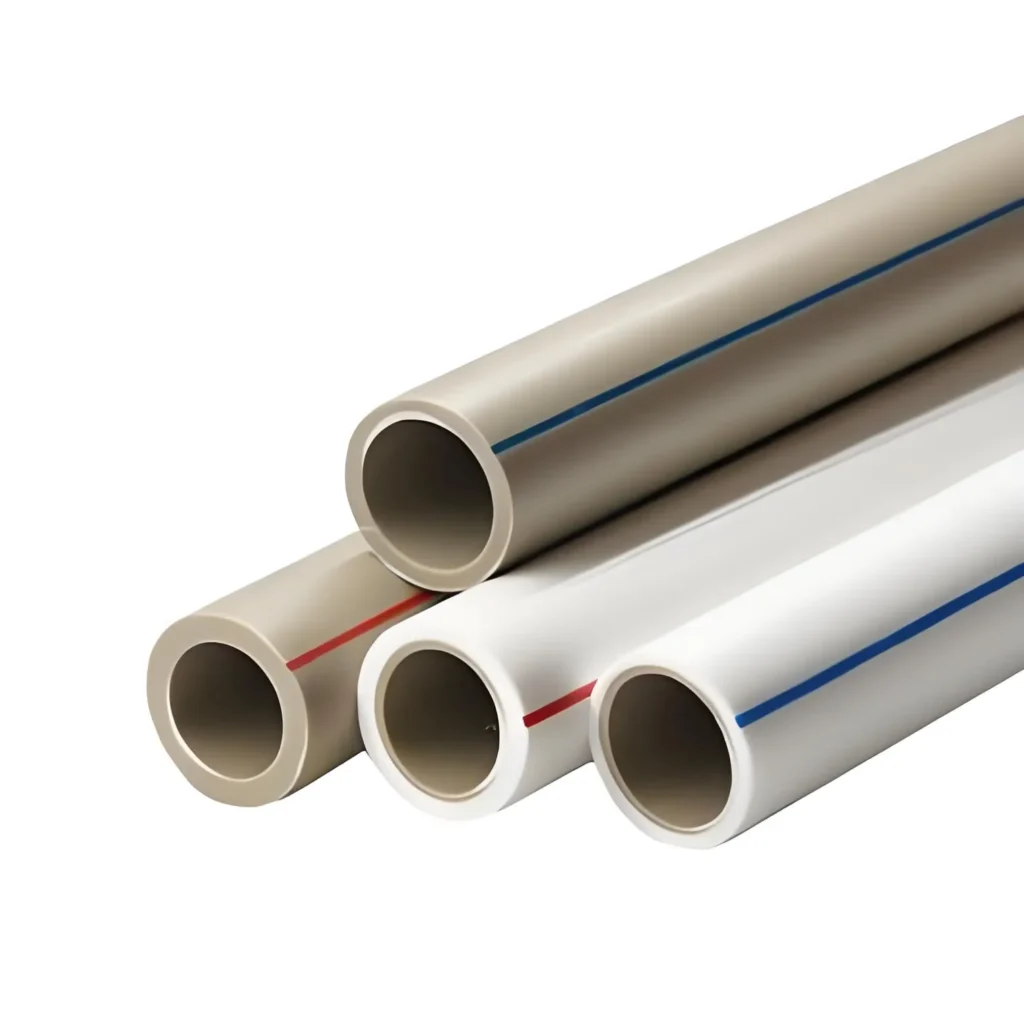
PPR Water Pipe: The “Blue Artery” of Modern Building Concealed Engineering
Beneath the walls and floors of modern buildings lies a critical yet often overlooked circulatory system—the water supply network. Within it, Polypropylene Random Copolymer pipe, commonly known as PPR pipe, has become the absolute mainstream choice for cold and hot water distribution systems worldwide due to its outstanding overall performance, earning it the title of the “blue artery” of modern construction.
I. Birth and Material Revolution: What is PPR?
The scientific name for PPR is Polypropylene Random Copolymer. It is the third-generation polypropylene piping material, succeeding homopolymer polypropylene (PP-H, Type 1) and block copolymer polypropylene (PP-B, Type 2). Its revolutionary nature lies in the random insertion of polyethylene molecules into the polypropylene molecular chain, perfectly combining polypropylene’s high-temperature resistance and strength with polyethylene’s low-temperature resistance and impact strength.
This microscopic tuning in materials science led to a macroscopic leap in performance. After its initial development and promotion in Europe in the 1980s, it rapidly gained global popularity, triggering a fundamental shift in building water supply piping from metal pipes (galvanized steel, copper) to full plastic pipes.
II. Core Advantages: Why Has PPR Become Dominant?
Compared to traditional pipes, the advantages of PPR pipes are comprehensive:
- Excellent Heat and Pressure Resistance: Can withstand long-term operational temperatures up to 70°C and short-term temperatures up to 95°C. With a service life exceeding 50 years under standard temperature and pressure, it perfectly meets household hot and cold water needs.
- Never Corrodes or Scales: As an inert polymer, PPR pipe is non-reactive to ions and chemicals in water, completely eliminating rust and corrosion. This fundamentally prevents issues like “yellow water” or “rusty water” caused by pipe deterioration. Its smooth inner wall offers low flow resistance and resists scale buildup, ensuring water purity and stable flow.
- Heat Fusion Jointing, Seamless Integration: The most revolutionary installation method for PPR pipe is socket heat fusion jointing. Using a specialized welding tool, the pipe and fitting are heated and fused directly. After cooling, the joint becomes a monolithic, fully sealed unit with strength greater than the pipe itself. This彻底解决了传统管道螺纹连接易漏水的痼疾 (completely solves the chronic leakage problem of traditional threaded pipe connections), achieving “one weld, a lifetime without leaks.”
- Lightweight, Energy-Efficient, and Eco-Friendly: Weighing only about 1/9th of galvanized steel pipe, it’s easy to transport and install. Its production requires low energy, and it is recyclable. Good thermal insulation properties reduce heat loss during hot water transport.
- Cost-Effective: Considering material cost, installation cost, maintenance, and long service life, its total lifecycle cost is significantly lower than traditional metal pipes.
III. Technical Points and Standard Systems
Not all PPR pipes on the market are equal. Quality depends on key indicators:
- Raw Material Grade: High-quality PPR pipes use 100% premium imported or domestic raw materials (e.g., Borealis, Borouge), ensuring pure and stable performance. Inferior pipes may contain recycled material, drastically reducing performance.
- S-Value Series: Indicates pipe wall thickness and pressure rating. Common series are S5, S4, S3.2, S2.5. A smaller number indicates a thicker wall and higher pressure rating. S3.2 or S2.5 series are commonly used in home decoration.
- Diameter Specifications: Denoted by outer diameter (e.g., De20 for 20mm). Main water lines commonly use De20 and De25.
- Color: Common colors are white, gray, and green. Color alone doesn’t indicate quality, but premium material usually has uniform color without impurities. Opaque dark-colored pipes (e.g., green) offer better UV resistance.
Internationally, the ISO 15874 standard is followed. China implements the GB/T 18742 national standard. Purchasers should look for the standard number, raw material brand, and legitimate brand markings.
IV. Applications: The Ubiquitous Distribution Network
The application of PPR pipes extends far beyond ordinary households:
- Residential Construction: Main and branch lines for cold and hot water in apartments and villas.
- Public Facilities: Direct drinking water systems and central hot water systems in schools, hospitals, and hotels.
- Heating Systems: An ideal choice for piping in radiant floor heating (underfloor heating) systems.
- Industrial Sector: Used for conveying certain chemical fluids, compressed air, etc.
V. Challenges and Future Outlook
Despite its clear advantages, PPR pipe faces challenges: its linear expansion coefficient is relatively high, requiring consideration for expansion joints in long exposed runs; its UV resistance is limited, necessitating protection from direct outdoor exposure over time.
Looking ahead, PPR pipe technology continues to evolve:
- Fiber Reinforced PPR: Incorporates materials like glass fiber to significantly reduce thermal expansion and increase rigidity, suitable for more demanding exposed installations.
- Aluminum-Plastic Composite PPR: A middle aluminum layer acts as an oxygen barrier and enhances dimensional stability, used in high-end heating systems.
- Antibacterial PPR: Incorporates special antibacterial materials for locations with extremely high hygiene requirements.
Conclusion
From kitchens to bathrooms, from homes to cities, PPR water pipes carry the safe flow of the source of life with their silent and reliable quality. It is more than just a piece of plastic tubing; it is the crystallization of materials science, manufacturing technology, and modern engineering philosophy. Choosing a high-quality PPR pipeline means infusing a building with a healthy, long-lasting “blue artery.” Hidden from view, it safeguards the safety and purity of daily water use for decades. As green building and healthy housing become common goals, PPR pipe will continue to serve as a cornerstone material, flowing towards an even broader future.